


Toyota Tacoma Wheel and Tire Fitment Guide: 1995 to Present, TRD Pro and Trailhunter
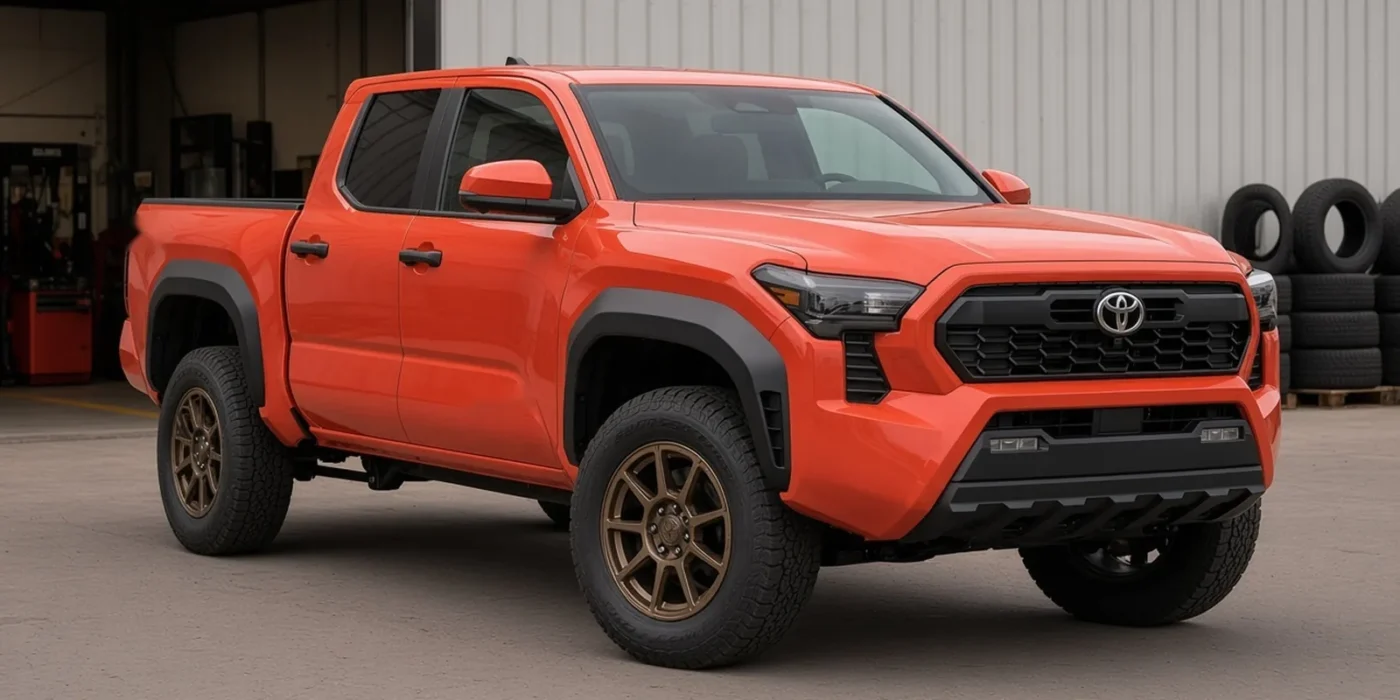
Every 2016-and-newer Tacoma, and every 1995–2015 4WD or PreRunner, uses a 6×139.7 (6×5.5) bolt pattern; 1995–2015 2WD trucks that are not PreRunners use 5×114.3. The 2024-and-newer truck moved to a 95.1 mm hub and M14 x 1.5 studs, replacing 106.1 mm and M12 x 1.5. Torque is 83 lb-ft through 2023, then 97 lb-ft on alloy wheels.
The two Tacoma mistakes we work hardest to catch are easy to describe. The first is a 2005–2015 2WD truck ordered with 6-lug wheels when it has five lugs. The second is newer: a 2024-and-newer owner who assumes wheels and lug nuts from a 2016–2023 truck carry over because the bolt pattern did not change. The pattern stayed at 6×139.7, but the hub, the studs, the torque spec, and the factory offset all changed. This guide sorts out which truck you have, then covers lug hardware, factory wheel and tire sizes, offsets, what fits on stock, leveled, and lifted trucks, and what is different on the TRD Pro and Trailhunter. We built it from Toyota owner’s manuals and Toyota press material, cross-checked against fitment databases. Where a number comes from a database rather than Toyota, or the sources disagree, we say so.
How we approach a Tacoma order: generation first, then tire size, then the wheel. Our Toyota Tacoma wheels and tires page only shows wheels and tires that fit the year, drivetrain, and trim you enter, and those results are covered by our 100% Fitment Guarantee. Read this first so you know what to enter, especially on a 2015-or-older 2WD or a 2024-and-newer truck.
What bolt pattern, center bore, and lug thread does each Tacoma generation use?
Two bolt patterns, three hub sizes, and two stud threads across four generations. Toyota’s owner’s manuals do not print the bolt circle or hub diameter, but they do split the wheel-nut tightening diagrams into “two-wheel drive models except PreRunner” and “four-wheel drive models and PreRunner” in the 2004, 2005, and 2014 books, and that split is the 5-lug versus 6-lug line. The bore and thread figures below are from fitment databases that agree with each other, and the torque figures are from Toyota’s manuals.
| Generation | Model years | Bolt pattern | Stud thread | Center bore | Factory lug torque (owner’s manual) |
|---|---|---|---|---|---|
| 1st gen, 4WD and PreRunner | 1995–2004 | 6×139.7 (6×5.5) | M12 x 1.5 | 106.1 mm | 83 lb-ft (110 N·m) in the 2004 manual |
| 1st gen, 2WD except PreRunner | 1995–2004 | 5×114.3 (5×4.5) | M12 x 1.5 (databases; confirm) | 60.1 mm (databases; confirm) | 83 lb-ft (110 N·m) in the 2004 manual |
| 2nd gen, 4WD and PreRunner | 2005–2015 | 6×139.7 (6×5.5) | M12 x 1.5 | 106.1 mm | 113 N·m; printed as 85 lb-ft in the 2005 manual and 83 lb-ft in the 2011 and 2014 manuals |
| 2nd gen, 2WD except PreRunner (incl. X-Runner) | 2005–2015 | 5×114.3 (5×4.5) | M12 x 1.5 (databases; confirm) | 60.1 mm (databases; confirm) | Same as the 6-lug truck |
| 3rd gen, all | 2016–2023 | 6×139.7 (6×5.5) | M12 x 1.5 | 106.1 mm | 83 lb-ft (113 N·m) in the 2023 manual |
| 4th gen (N400), all, incl. TRD Pro and Trailhunter | 2024–present | 6×139.7 (6×5.5) | M14 x 1.5 | 95.1 mm | 97 lb-ft (131 N·m) aluminum; 154 lb-ft (209 N·m) steel in the 2024 manual |
The 2024 change is the one to watch. The 2024 Tacoma owner’s manual lists two torque figures, 97 lb-ft (131 N·m) for aluminum wheels and 154 lb-ft (209 N·m) for steel wheels, where every earlier book we checked lists one. Toyota also tells owners to retighten the wheel nuts within 100 miles after a tire change, never to oil or grease the studs, and to tighten in sequence two or three times until every nut reaches spec. We go further on aftermarket wheels and re-check after the first 25 to 50 miles. New wheels seat in, and the nut that was right in the driveway is not always right on Friday.
The 1995–2023 figure barely moved. The 2004 Tacoma owner’s manual lists 110 N·m (83 lb-ft). The 2005 book lists 113 N·m but prints it as 85 lb-ft, and the 2011 and later books print the same 113 N·m as 83 lb-ft, so the 2005 number is a rounding difference in the book, not a different spec. If you are working from an old printed manual and see 85, that is why.
How do I tell a 5-lug 2WD Tacoma from a 6-lug truck?
Count the lug nuts. On a 1995–2015 truck the badge on the bed is not enough, because a 2WD PreRunner looks like a 4WD truck and is 6-lug, while a 2WD truck that is not a PreRunner, including the lowered X-Runner sport truck, is 5-lug. On a used truck, we trust a photo of one wheel over the build sheet. 6-lug trucks of any year can start with our 6×5.5 wheels and filter by offset.
For a 5-lug 2WD truck, the catalog is a car-and-crossover pattern. Our 5×114.3 wheels page lists them, but most are built for cars, not a pickup’s weight. Check the wheel’s load rating against the truck before you check the style.
What wheel and tire sizes came on each Tacoma?
Wheel and tire sizes come from Toyota’s owner’s manuals. Toyota does not print offsets in those books, so the offsets below come from fitment databases and OE wheel listings that agree with each other. Where they do not agree, we say so in the table. Diameters are calculated from the tire size and rounded.
| Generation or trim | Factory wheel and offset | Factory tire | Approx. tire diameter |
|---|---|---|---|
| 1st gen 2WD, 5-lug (1995–2004) | 15 x 6 (one database lists +40 mm; confirm); 16 x 6.5 on the S-Runner; 14-inch wheels on early trucks | P205/75R15; P235/55R16 (S-Runner); P195/75R14 and P215/70R14 in earlier books | 27.1 in.; 26.2 in.; 25.5 in. and up |
| 1st gen 4WD and PreRunner, 6-lug (1995–2004) | 15 x 7 or 16 x 7 at about +15 mm | P225/75R15, P265/75R15, 31×10.50R15LT; P265/70R16 | 28.3 to 31 in.; 30.6 in. |
| 2nd gen 2WD, 5-lug (2005–2015) | 15 x 6 (one database lists +34 mm; confirm); X-Runner 18 x 8 | P215/70R15; P255/45R18 (X-Runner) | 26.9 in.; 27.0 in. |
| 2nd gen 4WD and PreRunner (2005–2015) | 16 x 7 or 17 x 7.5 at about +30 mm; 18 x 7.5 on later trucks | P245/75R16, P265/70R16, P265/65R17; P265/60R18 | 30.5 to 30.6 in. |
| 3rd gen (2016–2023) | 16 x 7 at about +25 mm; 17 x 7.5 or 18 x 7.5 at about +30 mm; TRD Pro and some TRD Off-Road wheels listed lower, about +10 to +13 mm (confirm) | P245/75R16; 265/70R16 (TRD Off-Road, TRD Pro); P265/65R17; P265/60R18 | 30.5 to 30.6 in. |
| 4th gen SR, SR5 and similar (2024–present) | 17 x 7 at about +60 mm; 17 x 7.5 at about +55 mm | 245/70R17; 265/70R17 (TRD PreRunner, TRD Off-Road) | 30.5 in.; 31.6 in. |
| 4th gen TRD Sport, Limited, TRD Off-Road hybrid | 18 x 7.5 at about +55 mm; 18 x 8 at about +45 mm | 265/65R18; 265/70R18 on 18 x 7.5 (TRD Off-Road with i-FORCE MAX) | 31.6 in.; 32.6 in. |
| 4th gen TRD Pro and Trailhunter | 18 x 8.5 (Toyota); +20 mm per OE wheel listings, while two databases list 18 x 9 at +15 mm (confirm) | 265/70R18 116T Goodyear Territory R/T (Toyota calls it a 33) | 32.6 in. |
Two things stand out. First, factory 6-lug Tacoma tires sat right around 30.5 inches from 2005 through 2023, and the newest trucks only reach 31.6 to 32.6. A Tacoma owner who wants a 33 is asking for a real change, not a small step. Second, look at the offsets. Older trucks ran about +15 to +30 mm. Most 2024-and-newer trucks run about +45 to +60 mm. That gap of 25 to 35 mm is why a wheel that looked right on a 2018 can sit an inch farther out on a 2025 at the same width.
A note on the “33-inch” trucks. Toyota’s 2024 Tacoma i-FORCE MAX press release calls the TRD Pro and Trailhunter tires 33-inch Goodyear Territory R/Ts, and says both trucks sit two inches higher in front and an inch and a half higher in back than an i-FORCE SR5. The manual lists the tire as 265/70R18 116T, which works out to about 32.6 inches on paper. When we size a step up from a TRD Pro, we start from the real number. It is also a standard-load tire, not an LT, which matters when owners compare it to the LT 33s they used to run.
How do offset and backspacing change what fits on a Tacoma?
Offset is the distance in millimeters from the wheel’s centerline to its mounting face. Positive offset tucks the wheel in toward the frame; negative pushes it out. Backspacing is the distance in inches from the mounting face to the inner lip, and on a Tacoma it decides whether a wide tire touches the upper control arm. The two are linked by width, so neither number means much alone. Our wheel offset and backspacing calculator does the conversion for any width and offset.
The table compares common sizes against two factory baselines: a 2016–2023 16 x 7 at +25 mm and a 2024-and-newer 17 x 7.5 at +55 mm. The figures are geometry, calculated from width and offset, so they apply to any brand.
| Wheel | Backspacing | Outer lip vs. 2016–2023 16 x 7, +25 mm | Outer lip vs. 2024+ 17 x 7.5, +55 mm |
|---|---|---|---|
| 16 x 7, +25 mm (2016–2023 factory) | 4.98 in. | Baseline | 0.93 in. farther out |
| 17 x 7.5, +55 mm (2024+ factory) | 6.42 in. | 0.93 in. farther in | Baseline |
| 18 x 8.5, +20 mm (2024+ TRD Pro, per OE listings) | 5.54 in. | 0.95 in. farther out | 1.88 in. farther out |
| 17 x 8, 0 mm | 4.50 in. | 1.48 in. farther out | 2.42 in. farther out |
| 17 x 8.5, 0 mm | 4.75 in. | 1.73 in. farther out | 2.67 in. farther out |
| 17 x 9, -12 mm | 4.53 in. | 2.46 in. farther out | 3.39 in. farther out |
The right-hand column is the one 2024-and-newer owners should read twice. A 17 x 8.5 at 0 mm, a common choice on a 2016–2023 truck, sits about 2.7 inches farther out on a new truck than the factory wheel does. That is a lot of poke on a truck whose factory fenders were drawn around +55 mm. It is also more leverage on the wheel bearings and steering parts. On a 2024-and-newer truck we start most builds closer to the factory offset and let the tire do the work.
For a leveled 2005–2023 truck on 33s, most builds land on a 16 or 17 x 8 to 8.5 near 0 mm, or a 17 x 9 near -12 mm. Treat that as typical, not a spec. If you already know you want a 9-inch wheel, our 17×9 6×5.5 wheels page is where we would start.
What size tires fit a Tacoma on stock suspension, a leveling kit, and a lift?
The table shows the starting points our specialists use for 2005–2023 4WD and PreRunner trucks, the largest pool of Tacomas we see. These are typical ranges, not Toyota specs and not a guarantee. A tire that clears with the truck parked can still touch at full lock, under compression, or with a loaded bed.
| Tire | Stock height | Leveling kit (about 2 to 3 in. front) | 3 in. or more of lift | Typical wheel and offset |
|---|---|---|---|---|
| About 31 in. (265/70R17, 265/75R16 class) | Fits | Fits | Fits; more lift than this tire needs | 16 x 7 to 17 x 8, about 0 to +30 mm |
| About 32 in. (275/70R17, 255/75R17 class) | Usually fits; light rub at full lock is possible | Fits | Fits | 16 or 17 x 7.5 to 8, about 0 to +25 mm |
| 33 in. (285/70R17, 285/75R16, 255/80R17 class) | Usually rubs | The usual home for 33s, often with trimming | Fits | 16 or 17 x 8 to 9, about 0 to -12 mm |
| 35 in. (35×12.50R17, 315/70R17 class) | No | No | With aftermarket upper control arms, trimming, and usually a body mount modification | 17 x 8.5 to 9, about 0 to -12 mm |
Our Tacoma lander lists the same pattern of common fitments: 16 x 8 with 265/70R16 and 17 x 8.5 with 265/70R17 or 275/70R17 on stock and mild setups; 17 x 9 with 285/70R17 on leveled and trail trucks; and 17 x 9 or 17 x 10 with 35×12.50R17 on properly lifted trucks. If a 33 is the goal, our 285/70R17 tires page is the place to compare tread patterns and load ranges.
Where do 33s rub on a Tacoma?
In our experience the contact points show up in roughly this order on 2005–2023 trucks:
- Front mud flaps and the lower front valance. The first thing a taller tire touches at full lock. Most owners remove the flaps before anything else.
- The cab mount behind the front wheel. The well-known Tacoma contact point with 33s, especially in reverse at full lock. Fixing it means trimming or modifying the mount, which is a body-shop job, not a driveway job.
- Front of the fender liner and the plastic bumper corners. Contact at full lock and under compression. Heat-forming or trimming usually handles it.
- Upper control arm. A wide tire on a wheel with too much backspacing touches the upper arm, especially after a leveling kit steepens the arm angle. Less backspacing is the cleaner fix; a spacer is not our first choice.
What changes on 2024-and-newer trucks?
The 2024 truck is a new platform, and it has fewer years of aftermarket data behind it than the 2016–2023 truck. Three things change our approach. The factory offsets are much higher, so the offset you pick moves the tire farther than it did on older trucks. Toyota does not offer a 16-inch wheel on any 2024-and-newer grade, so we do not assume a 16 clears the brakes; we check every wheel. And the driver-assist system cares about tire size and ride height.
That last point is written into the 2024 Tacoma manual, in the Toyota Safety Sense 3.0 section. Toyota says the system operates normally on factory suspension with factory tire sizes. With Toyota’s genuine 2.5-inch lift kit and tires up to 3 inches larger than factory, the system “may not operate properly” and Toyota tells owners to have a dealer verify and change the settings. Other tire sizes on stock suspension, or larger tires on the genuine lift, fall outside what the system is designed for, and a non-genuine lift requires a Toyota facility to disable the system’s functions. Read that section before you plan a lift and 35s on a new truck.
Will 4Runner, Tundra, Silverado, or Ram 6×139.7 wheels fit a Tacoma?
Same bolt pattern does not mean same wheel. The 2010–2024 4Runner uses the same 106.1 mm hub and M12 x 1.5 studs as 2005–2023 Tacomas, and the 2025-and-newer 4Runner moved to the same 95.1 mm hub and M14 x 1.5 studs as the 2024-and-newer Tacoma, according to fitment databases. Factory offsets and load ratings still differ, so check both. Our Toyota 4Runner wheels page covers the 4Runner side.
GM and Ram factory wheels go the other way. The Silverado 1500 and Sierra 1500 use a 78.1 mm bore and the Ram 1500 uses 77.8 mm, both far smaller than any Tacoma hub, so a factory wheel from either truck will not sit on a Tacoma. Most aftermarket 6×139.7 wheels are bored large enough for Toyota hubs and center with a ring. Our Ram 1500 fitment guide covers the Ram side of that comparison.
What lug nuts and hub-centric rings does a Tacoma need with aftermarket wheels?
Three things have to match: thread, seat, and length. Thread is M12 x 1.5 through 2023 and M14 x 1.5 from 2024, according to the fitment databases we checked. Seat is set by the wheel, not the truck, and this is where Tacomas catch people. Toyota alloy wheels clamp against a flat washer on the nut; the 2024 manual describes tightening until “the washer of the nut” contacts the wheel, and the tapered end of the nut is for the steel wheels. Most aftermarket wheels use a 60-degree conical seat. Factory Toyota alloy nuts on a conical-seat wheel will not clamp the way the wheel was designed to.
Hub-centric rings bridge the gap between a wheel’s larger center bore and the hub: 106.1 mm on 6-lug 1995–2023 trucks, 95.1 mm on 2024-and-newer. One source lists the new hub at 95.2 mm instead of 95.1, so we measure when a ring has to be exact. A wheel bored to 95.1 mm for the new truck will not fit an older 106.1 mm hub at all.
Can I move my 2016–2023 wheels to a 2024-and-newer Tacoma?
They bolt on, but plan for parts. The 106.1 mm bore clears the new 95.1 mm hub, so you need a 106.1 to 95.1 mm ring. The old M12 nuts will not thread onto M14 studs, and wheels drilled for M12 studs can have lug holes too narrow for some M14 nuts, so the nut has to match both the stud and the hole. Never drill out a wheel’s lug holes. Then check the offset: a factory 16 x 7 at +25 mm sits about an inch farther out than the new truck’s 17 x 7.5 at +55 mm. And confirm the wheel clears the newer truck’s brakes before you mount tires.
Will TPMS work with new wheels on a Tacoma?
Federal rules require a TPMS on light trucks like these. FMVSS 138 was phased in from the 2006 model year and required all covered light vehicles by September 1, 2007, which generally means the 2008 model year. The rule, published in the Code of Federal Regulations at 49 CFR 571.138, requires a low-pressure warning when a tire falls 25 percent below the recommended cold pressure, and owner’s manual language warning that replacement tires or wheels can stop the system from working.
The process changed with the generations. The 2023 Tacoma owner’s manual says new sensor ID codes must be registered in the truck’s computer and tells owners to have that done by a Toyota dealer; a shop with the right TPMS tool can usually do it too. The 2024-and-newer manual adds a register procedure in the Vehicle Settings menu on trucks with the 7-inch display, and says the system can store two registered wheel sets, which makes a second set for winter or the trail easier to live with.
In practice, healthy factory sensors often move to aftermarket wheels that accept a valve-stem sensor. Our explainer on whether your old TPMS sensors can move to new wheels covers when to reuse sensors and when to replace them. One more check: a larger LT tire may want a different cold pressure than the placard. If it does, initialize the system at the new pressure; Toyota’s manuals say initialization sets the current pressure as the system’s benchmark.
Does a bigger tire change gearing and the speedometer?
Yes, on both counts. A taller tire covers more ground per revolution, so the speedometer reads low and the effective axle ratio drops. The math: effective ratio equals the axle ratio times the old tire diameter, divided by the new tire diameter. A truck geared at 3.91 on a factory 265/70R16 (about 30.6 inches) stepping to a 33 lands near 3.63. A 35 drops it to about 3.42. On a Tacoma that tows or climbs grades loaded, that is the difference between a truck that holds its gear and one that hunts. Have the tire size recalibrated after a size change so the speedometer and odometer stay accurate.
What load rating do Tacoma wheels and tires need?
Each wheel carries a maximum load rating from its maker, and each tire carries a load index. The placard on the driver’s door jamb gives the factory tire size and pressure, and Toyota’s manuals list the load index of each factory tire. Replacement tires should not have a lower load index than the originals, and the wheel should be rated for the truck’s weight with margin for a loaded bed, a rooftop tent, or a trailer. Overland builds get heavy fast. Our Search By Vehicle tool filters Tacoma wheels by load rating along with bolt pattern, offset, and center bore, and every order is reviewed by a fitment specialist.
LT tires add stiffer construction and higher load ranges than P-metric and standard-load tires. They ride firmer and weigh more, and on a midsize truck the weight shows up in braking and fuel use. On a daily driver that rarely carries much, a standard-load or XL tire at the right load index is often the better match. On a heavy overland build, we would rather go LT.
How do we build a Tacoma wheel and tire package?
We recommend a complete set on most Tacoma builds, because tire size, wheel width, and offset have to be chosen together. We mount and balance every package on Hunter equipment, and TPMS, lug hardware, hub-centric rings, and Road Force balancing are options at checkout. Our guide to how we mount and balance packages explains what happens before a set ships.
Before an order ships, a specialist runs a 5-point check of bolt pattern, offset, center bore, width, and brake clearance. On a Tacoma, the bolt pattern line catches 5-lug 2WD trucks entered as 6-lug, and the center bore line catches 2024-and-newer trucks. Our 100% Fitment Guarantee page explains what is covered. Changing the tire size away from what our Search By Vehicle tool recommends can void it, so tell us about your leveling kit or lift before you order, not after.
Wheels ship out in 2 to 4 business days and mounted packages in 4 to 8, by FedEx Ground, to the lower 48 states. Eligible unused products can be returned within 60 days, subject to the conditions on our returns page.
What should you check before you order Tacoma wheels and tires?
Run this list in order. It is the same order our specialists use on the phone.
- Identify the generation, drivetrain, and trim. Note the model year and count the lugs: six on every 2016-and-newer truck and on 1995–2015 4WD and PreRunner trucks, five on 1995–2015 2WD trucks that are not PreRunners. Note TRD Pro, Trailhunter, or TRD Off-Road, and any lift.
- Read the door placard. Write down the factory tire size, load index, and cold inflation pressure. Replacement tires should not have a lower load index than the originals, and the wheel’s load rating should suit the truck and what you carry.
- Choose the tire size first. Decide on the tire for how you use the truck, then the suspension it typically needs: stock for about 31 to 32 inches on a 2005–2023 truck, a leveling kit for 33s, and a 3-inch or larger lift with supporting parts for 35s.
- Pick wheel diameter, width, and offset for that tire. Start from your generation’s factory offset (about +25 to +30 mm on 2005–2023 trucks, about +45 to +60 mm on most 2024-and-newer trucks), run the numbers in an offset and backspacing calculator, and check brake clearance.
- Confirm bolt pattern, center bore, and lug hardware. Match 6×139.7 or 5×114.3 to your truck, use a hub-centric ring if the wheel bore is larger than 106.1 mm (95.1 mm on 2024-and-newer), and buy lug nuts in the right thread (M12 x 1.5 through 2023, M14 x 1.5 from 2024) with the seat the wheel calls for.
- Plan TPMS. Order sensors or confirm your old ones are healthy and compatible, have the new sensor IDs registered to the truck after installation, and check that the TPMS light is off.
- Plan driver-assist and speedometer checks. On 2024-and-newer trucks, read the Toyota Safety Sense section of the owner’s manual before changing tire size or lift height. On any year, have the tire size recalibrated if the speedometer reads off.
- Install, torque, and re-check. Torque the lug nuts to your year’s spec in a star pattern with a torque wrench (83 lb-ft through 2023; 97 lb-ft alloy or 154 lb-ft steel from 2024), re-check after the first 25 to 50 miles, and get an alignment if lift, tire size, or offset changed.
Frequently asked questions
What is the bolt pattern on a Toyota Tacoma?
Every 2016-and-newer Tacoma uses 6×139.7 (6×5.5), and so do 1995–2015 4WD and PreRunner trucks. 1995–2015 2WD trucks that are not PreRunners, including the X-Runner, use 5×114.3 (5×4.5). Count the lug nuts before you order if the truck is a 2015 or older 2WD.
Is a 2WD Tacoma 5-lug or 6-lug?
It depends on the year and model. From 1995 to 2015, a 2WD PreRunner has six lugs and a 2WD truck that is not a PreRunner, including the X-Runner, has five. From 2016 on, every Tacoma has six lugs, 2WD or 4WD.
What size lug nuts does a Tacoma use?
Fitment databases list M12 x 1.5 studs on 1995–2023 Tacomas and M14 x 1.5 on 2024-and-newer trucks. Toyota alloy wheels seat on a flat-washer nut, while most aftermarket wheels need a 60-degree conical-seat nut, so most aftermarket wheels need new lug nuts.
What is the lug nut torque on a Toyota Tacoma?
Toyota lists 83 lb-ft for 1995–2023 Tacomas (110 N·m in the 2004 manual, 113 N·m in later books). The 2024-and-newer manual lists 97 lb-ft (131 N·m) for aluminum wheels and 154 lb-ft (209 N·m) for steel wheels. Tighten in a star pattern on clean, dry studs.
What is the center bore on a Tacoma?
Fitment databases list 106.1 mm for 6-lug 1995–2023 Tacomas and 95.1 mm for 2024-and-newer trucks. 5-lug 2WD trucks are listed at 60.1 mm. Use a hub-centric ring when the wheel bore is larger than the hub.
Will 2016–2023 Tacoma wheels fit a 2024 Tacoma?
They bolt on, because the bolt pattern is the same and the 106.1 mm bore clears the 95.1 mm hub, but they are not a direct fit. You need M14 x 1.5 nuts that fit the wheel’s seat and lug holes, a 106.1 to 95.1 mm hub-centric ring, and a check of load rating and offset, since the newer truck’s factory offsets run about +45 to +60 mm on most grades.
What size tires fit a stock Tacoma?
Stock 2005–2023 6-lug Tacomas typically run up to about 31 to 32 inches, such as 265/70R17 or 275/70R17, with minor rubbing possible at full lock. 2024-and-newer TRD Pro and Trailhunter trucks come on 265/70R18, about 32.6 inches. Treat these as typical, not guaranteed.
What size tires fit a leveled Tacoma?
With a typical front leveling kit, many 2005–2023 Tacomas run 33-inch tires such as 285/70R17 or 285/75R16 on a 16- or 17-inch wheel at about 0 to -12 mm, usually with some trimming at the front of the fender liner and the cab mount. Treat this as typical, not guaranteed.
Who can check your Tacoma build before you order?
Send us the year, drivetrain, trim, suspension, and the tire size you want, and a specialist will tell you what fits and what it will take. You can contact a fitment specialist online at any hour, or call or text 1-866-757-4679 Monday through Friday, 8:30 AM to 6:00 PM Eastern. If the honest answer is that your 2WD truck needs 5-lug wheels or your new truck needs a different offset than your old one, we will tell you before you spend the money.
Want to hear from other truck owners first? Our customer reviews page shows our 4.8-star Shopper Approved rating across 2,045 reviews.

