


Chevy Silverado 1500 and GMC Sierra 1500 Wheel and Tire Fitment Guide: 2007 to Present, Trail Boss, ZR2, AT4, AT4X and Denali
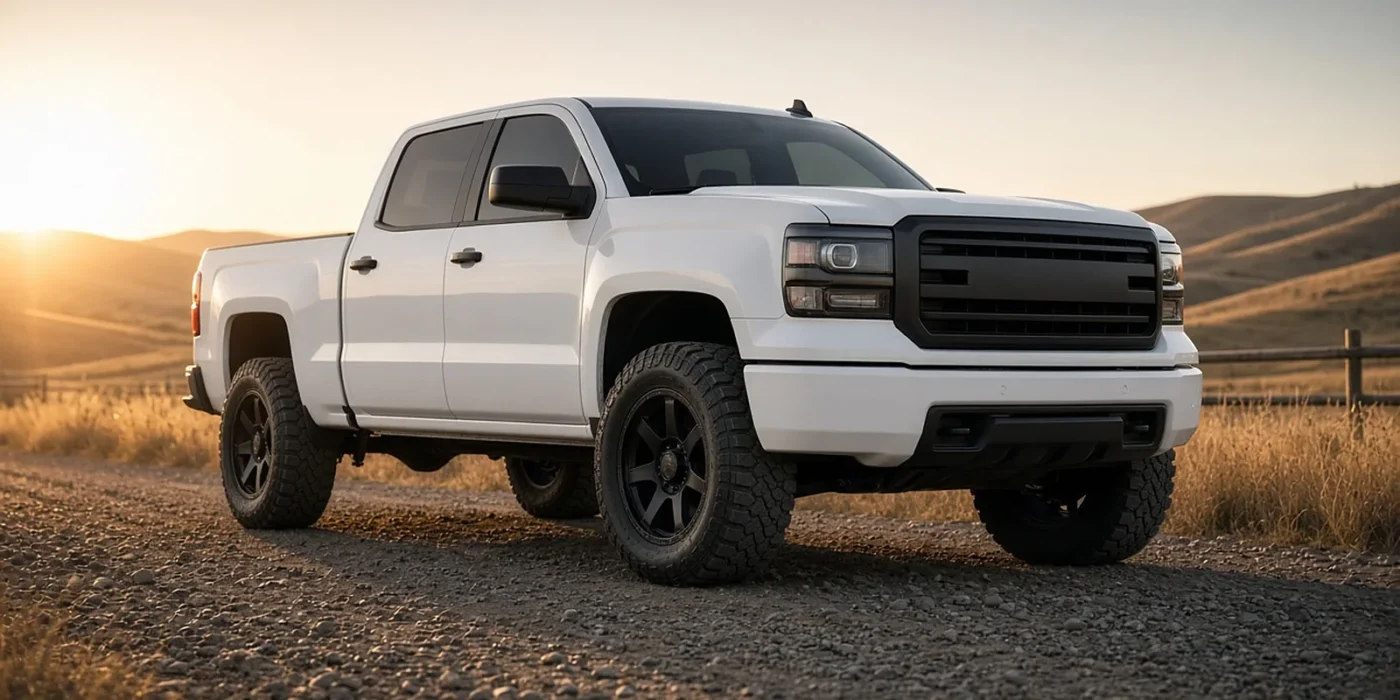
Every 2007–2026 Chevy Silverado 1500 and GMC Sierra 1500, including the Trail Boss, ZR2, AT4, AT4X, and Denali, uses a 6×139.7 (6×5.5) bolt pattern, a 78.1 mm center bore, and M14 x 1.5 studs. GM specifies 140 lb-ft of lug torque. Stock trucks typically clear 32- to 33-inch tires, and 35s usually need a lift.
That answer covers most of the half-ton GM questions that reach our fitment desk. The hardware is the easy part, because it has barely changed in two decades. The trouble is everything around it: factory offsets that moved from +31 mm to +24 mm and back up, trims that leave the plant with a 2-inch lift, front valances and cab mounts that eat tires at full lock, and a new 2027 truck that GM has not fully published specs for yet. We built this guide from GM owner’s manuals, GM and GMC fact sheets and order guides, and cross-checked fitment databases. Where a number is a typical range and not a GM spec, we say so.
How we approach a Silverado order: tire size first, then suspension, then the wheel. Our Chevy Silverado 1500 wheels and tires page only shows wheels and tires that fit the year, trim, and suspension you enter, and those results are covered by our 100% Fitment Guarantee. Read this guide first so you know what to enter.
The GMC side is the same truck under different sheet metal. Sierra 1500 and Silverado 1500 share the frame, hubs, brakes, and wheel hardware in every generation covered here, so every number below applies to both unless we call out a trim. Sierra owners can shop the same way on our GMC Sierra 1500 wheels page.
What bolt pattern, center bore, and lug thread does each Silverado and Sierra 1500 generation use?
All of them use six lugs on a 139.7 mm circle, written 6×139.7 or 6×5.5. The hub (center bore) is 78.1 mm and the studs are M14 x 1.5. GM prints the same wheel nut torque in every half-ton owner’s manual we checked: 140 lb ft, given as 190 N·m. Unlike Ford, GM did not change the stud thread between generations, which is why wheels move between these trucks so easily. Offset is what changes, and the next section covers it.
| Generation | Model years | Bolt pattern | Stud thread | Center bore | Factory lug torque (owner’s manual) |
|---|---|---|---|---|---|
| GMT900 | 2007–2013 (new body) | 6×139.7 (6×5.5) | M14 x 1.5 | 78.1 mm | 140 lb-ft (190 N·m) |
| K2XX | 2014–2018, plus 2019 Silverado LD and Sierra Limited | 6×139.7 (6×5.5) | M14 x 1.5 | 78.1 mm | 140 lb-ft (190 N·m) in the 2016 manual |
| T1XX (incl. Trail Boss, ZR2, AT4, AT4X) | 2019–2026, refreshed for 2022 (2022 Silverado LTD and Sierra Limited are the pre-refresh truck) | 6×139.7 (6×5.5) | M14 x 1.5 | 78.1 mm | 140 lb-ft (190 N·m) in the 2024 manual |
| Next generation | 2027–present | Reported as 6×139.7; confirm for your truck | Reported as M14 x 1.5; confirm | Reported as 78.1 mm; confirm | 140 lb-ft (190 N·m) reported from the 2027 manual |
The current figure comes from the Capacities and Specifications table in the 2024 Chevrolet Silverado 1500 owner’s manual, which lists wheel nut torque at 190 N·m, 140 lb ft. The same manual says to tighten the nuts with a torque wrench in a crisscross sequence, and to follow the aftermarket maker’s torque spec if you run accessory locking nuts. GM also warns that improperly tightened nuts can cause brake pulsation and rotor damage. On these trucks that is not a theoretical warning. A warped-feeling pedal after a tire shop visit is usually an impact gun, not a bad rotor.
For the previous generation, the 2016 Chevrolet Silverado owner’s manual prints the same 140 lb ft (190 N·m). It also says each replacement wheel should have the same load-carrying capacity, diameter, width, and offset as the one it replaces. GM’s position is conservative, and it is the right baseline. Every aftermarket wheel is a deliberate departure from it, so the departure should be measured, not guessed.
The 78.1 mm center bore is the hole that pilots the wheel on the hub. Many aftermarket 6×139.7 wheels are bored well over 100 mm so one casting fits Chevy, GMC, Toyota, and Nissan trucks. When the wheel bore is bigger than the hub, the wheel centers on the lug nuts unless you add a hub-centric ring. On a half-ton that tows, a ring is cheap insurance against a vibration you chase for months.
Will 2014–2018 wheels fit a 2019-and-newer Silverado or Sierra, and the reverse?
Yes, in almost every case. The pattern, hub, and thread match from 2007 through 2026, so factory wheels bolt up across GMT900, K2XX, and T1XX trucks. The checks are offset and the TPMS sensors. A 20 x 9 from a 2016 LTZ (+27 mm) sits within about a millimeter of a 2020 20 x 9 (+28 mm), so it looks factory. An 18 x 8 from a 2010 truck at +31 mm tucks in a little farther. If you are shopping by pattern, start with our 6×5.5 wheels and filter by offset, not just diameter.
What about the 2007 Silverado Classic and Sierra Classic?
GM sold the previous-generation GMT800 truck alongside the new one for 2007 as the Silverado Classic and Sierra Classic. Fitment databases list the same 6×139.7 pattern, 78.1 mm hub, and M14 x 1.5 thread, so the hardware carries over. Factory offsets and brake packages differ, so confirm which 2007 you have before ordering. The VIN and the door placard settle it in a minute.
What wheel and tire sizes came on each Silverado and Sierra 1500?
GM does not print factory offsets in the owner’s manual, so the table uses OE wheel listings cross-checked across several fitment databases and OE replacement-wheel listings. Where the databases disagree, they disagree by a few millimeters, and we show the figure most of them agree on. Diameters are calculated from the tire size and rounded.
| Generation | Factory wheel and offset | Typical factory tire | Approx. tire diameter |
|---|---|---|---|
| GMT900 (2007–2013) | 17 x 7.5, +31 mm | 245/70R17 or 265/70R17 | 30.5 in.; 31.6 in. |
| GMT900 (2007–2013) | 18 x 8, +31 mm | 265/65R18 | 31.6 in. |
| GMT900 (2007–2013) | 20 x 8.5, +31 mm | 275/55R20 | 31.9 in. |
| K2XX (2014–2018) | 17 x 8, +24 mm | 255/70R17 or 265/70R17 | 31.1 in.; 31.6 in. |
| K2XX (2014–2018) | 18 x 8.5, +24 mm | 265/65R18 | 31.6 in. |
| K2XX (2014–2018) | 20 x 9, +27 mm | 275/55R20 | 31.9 in. |
| K2XX (2014–2018) | 22 x 9, +24 mm | 285/45R22 | 32.1 in. |
| T1XX (2019–2026) | 17 x 8, +24 mm | 255/70R17 or 265/70R17 | 31.1 in.; 31.6 in. |
| T1XX (2019–2026) | 18 x 8.5, +26 mm | 265/65R18; LT275/65R18 or LT275/70R18 on off-road trims | 31.6 in.; 32.1 in.; 33.2 in. |
| T1XX (2019–2026) | 20 x 9, +28 mm | 275/60R20 | 33.0 in. |
| T1XX (2019–2026) | 22 x 9, +28 mm | 275/50R22 | 32.8 in. |
Two things jump out. First, GM dropped offsets by about 7 mm in 2014, so a K2XX or T1XX truck already sits its wheels slightly farther out than a GMT900. Second, the T1XX grew tire diameter at the same wheel size. A 2016 LTZ ran 275/55R20s at about 31.9 inches. A 2022 truck on 20s runs 275/60R20s at about 33.0 inches. That is a full inch of tire before anyone touches the suspension, and it is why a 2019-and-newer truck makes a 33 look easy.
For trim-level detail, the table below uses GM and GMC fact sheets and order-guide listings. GM moves equipment between packages almost every model year, so confirm on your own door placard before you treat any row as your truck.
| Trim | Factory wheel | Factory tire | Approx. tire diameter |
|---|---|---|---|
| Silverado Custom Trail Boss and LT Trail Boss (2019) | 18 in., 2-inch factory lift | LT275/65R18 Goodyear Wrangler DuraTrac | 32.1 in. |
| Silverado Custom Trail Boss (2025) | 18 in. High Gloss Black | LT275/65R18C Goodyear Wrangler Territory MT | 32.1 in. |
| Silverado LT Trail Boss (2025) | 20 in. High Gloss Black (18s optional) | 275/60R20 all-terrain | 33.0 in. |
| Silverado ZR2 (2022–2026) | 18 x 8.5, about +26 mm | LT275/70R18 Goodyear Wrangler Territory MT | 33.2 in. |
| Sierra AT4X (2022 launch) | 18 in. | 32-inch tires per GMC’s fact sheet | About 32 in. |
| Sierra AT4X (2025) | 18 in. painted aluminum | LT275/70R18 Goodyear Wrangler Territory MT | 33.2 in. |
| Sierra AT4 (2025) | 20 in. polished aluminum (18s optional) | 275/60R20 all-terrain; LT275/65R18C MT optional | 33.0 in.; 32.1 in. |
| Sierra Denali (2025) | 20 in. (22s optional) | 275/60R20 all-terrain; 275/50R22 optional | 33.0 in.; 32.8 in. |
| Sierra Denali Ultimate (2025) | 22 in. | 275/50R22 | 32.8 in. |
Note the pattern on the off-road trims: GM puts them on 18s with tall sidewalls, and the ZR2 and AT4X go to a 70-series tire. That is the factory telling you what works off pavement on this platform. When a customer with a ZR2 asks us for 22s, we will build it, but we will tell them what they are giving up first.
How do offset and backspacing change what fits on a Silverado or Sierra?
Offset is the distance in millimeters from the wheel’s centerline to its mounting face. Positive offset tucks the wheel in toward the frame. Negative offset pushes it out. Backspacing is the distance in inches from the mounting face to the inner lip, and on these trucks it decides whether a wide tire touches the upper control arm or the inner fender liner. The two are linked by width, so neither number means much alone. Our offset and backspacing calculator does the conversion for any width and offset.
Factory GM half-ton wheels run +24 to +31 mm. Most aftermarket truck wheels run far less. On our Silverado and Sierra landers, common offsets run about +18 to +27 mm for stock or near-stock fitment and 0 to -12 mm for leveled or lifted trucks after a wider stance. The table compares common sizes against a factory T1XX 20 x 9 at +28 mm. The figures are geometry, calculated from width and offset, so they apply to any brand.
| Wheel size | Offset | Backspacing | Lip to mounting face (front spacing) | Outer lip vs. a factory 20 x 9 at +28 mm |
|---|---|---|---|---|
| 18 x 8.5 (factory T1XX, ZR2) | +26 mm | 5.8 in. | 3.7 in. | About 0.2 in. farther in |
| 20 x 9 (factory T1XX) | +28 mm | 6.1 in. | 3.9 in. | Baseline |
| 20 x 9 | +18 mm | 5.7 in. | 4.3 in. | About 0.4 in. farther out |
| 20 x 9 | +1 mm | 5.0 in. | 5.0 in. | About 1.1 in. farther out |
| 20 x 9 or 17 x 9 | -12 mm | 4.5 in. | 5.5 in. | About 1.6 in. farther out |
| 20 x 10 | -18 mm | 4.8 in. | 6.2 in. | About 2.3 in. farther out |
| 20 x 10 | -24 mm | 4.6 in. | 6.4 in. | About 2.5 in. farther out |
| 20 x 12 or 22 x 12 | -44 mm | 4.8 in. | 8.2 in. | About 4.3 in. farther out |
Here is the part that surprises people. A 20 x 9 at +18 mm, which sounds mild, gives up 0.4 inches of backspacing against factory. That small move is often what clears a 12.50-wide tire from the upper control arm on a leveled truck. At the other end, a 20 x 12 at -44 mm has about the same backspacing as a 20 x 10 at -18 mm, so inner clearance is nearly identical, but the outer lip sits about two inches farther out. That is a styling choice, not a clearance fix. Big poke means more leverage on wheel bearings and steering parts, more spray down the bedsides, and in some states a question about fender coverage.
For a leveled or lifted Silverado or Sierra that still tows and commutes, most builds land on a 17, 18, or 20 x 9 between +18 and -12 mm, and 17 inch 6-lug wheels are a common starting diameter, or a 20 x 10 between -18 and -24 mm for 35s. Treat that as typical, not a spec. One documented example: a 2014 Silverado 1500 Z71 on 20 x 10 XD778 wheels at -12 mm with 35×12.50R20 tires, cleared with a 7-inch Rough Country lift.
What size tires fit a Silverado or Sierra 1500 on stock suspension, a leveling kit, and a lift?
The table shows the starting points our specialists use for 2014–2026 trucks. These are typical ranges, not GM specs and not a guarantee. GMT900 trucks run higher factory offset and a slightly smaller tire envelope, so knock them down roughly one row. Static clearance with the truck parked is half the test. At full lock, and with the suspension compressed over a dip or a loaded bed, the tire moves into space the valance, fender liner, and cab mount already use.
| Tire | Stock height | Leveling kit (about 2 in. front) or factory-lifted trim | 4 to 6 in. lift | Typical wheel and offset |
|---|---|---|---|---|
| About 32 in. (275/65R18, 285/55R20, 265/70R18 class) | Fits; GM fits LT275/65R18 on Trail Boss and AT4 | Fits | Fits; more lift than this tire needs | 18 x 9 or 20 x 9, about +18 to +27 mm |
| 33 in. (275/70R18, 275/60R20, 33×12.50R20 class) | 275/60R20 is factory on T1XX 20s; a 12.50-wide 33 often rubs the valance and liner at full lock | The usual home for 33s; ZR2 and AT4X ship on LT275/70R18 | Fits | 17 x 9, 18 x 9, or 20 x 9, about 0 to -12 mm |
| 34 to 35 in. (295/70R18, 285/75R18, 35×12.50R20 class) | No | 34s sometimes, with trimming; 35×12.50s usually need trimming and a cab mount modification | The usual setup for 35s | 20 x 10, about -18 to -24 mm; 18 x 9 near 0 mm for narrower 34s |
| 37 in. (37×12.50R20 class) | No | No | Six inches or more, plus trimming and a gearing conversation | 20 x 10, about -18 to -24 mm |
Our Silverado lander lists the same pattern from real orders: 265/65R18, 275/55R20, and 285/55R20 on stock and mild setups; 295/70R18, 33×12.50R17, and 33×12.50R20 on leveled daily and tow trucks; and 35×12.50R20 on properly lifted trucks. The factory-lifted trims start one step up. Our Silverado Trail Boss wheels page lists 33×12.50s on leveled Trail Boss builds and 35s with proper lift, offset, and trimming around the liners and mud flaps.
Where do 33s and 35s rub on a Silverado or Sierra?
In our experience the contact points show up in the same order on almost every 2014-and-newer half-ton:
- Front lower valance or air dam. The first thing a taller tire touches at full lock on trucks that have one. Many owners remove the plastic air dam for this reason.
- Front of the fender liner. Contact at full lock, worse when the suspension compresses. Heat-forming or trimming the liner usually fixes it.
- Rear of the fender liner and the cab mount. The classic GM rub. On wide 35s the tire reaches the pinch weld and the front cab mount at full lock in reverse. Clearing it often means a body mount modification, which is a cutting-and-welding job for a shop that does it regularly.
- Upper control arm. A wide tire on a wheel with too much backspacing contacts the upper arm or its ball joint, especially after a leveling kit steepens the arm angle. Less backspacing, not a spacer, is the cleaner fix.
- Mud flaps and running boards. Factory flaps on Trail Boss and AT4 trucks are a common contact point with wider tires and lower offsets.
A leveling kit raises the front to match the rear and does not add travel. A lift kit raises both ends, usually with new knuckles, crossmembers, or spacers. Both change front-end geometry, so plan an alignment either way. On a truck that tows, check how the kit affects headlight aim and trailer stance before you buy it.
How are the Trail Boss, ZR2, AT4, and AT4X different?
The hardware does not change. The 6×139.7 pattern, 78.1 mm hub, and M14 x 1.5 thread are the same on every trim. What changes is the starting point. The Trail Boss and AT4 come with a 2-inch factory lift, so they are already where a leveled base truck ends up. Chevrolet’s 2019 catalog lists the first Custom Trail Boss and LT Trail Boss on 18-inch wheels with LT275/65R18 Goodyear Wrangler DuraTrac tires and monotube shocks. Treat these trucks like a leveled truck that still has room for a tire size, not a stock truck with headroom for two.
The ZR2 goes further. Chevrolet’s 2022 Silverado ZR2 fact sheet lists Multimatic DSSV dampers, front and rear e-lockers, 18-inch wheels with 33-inch tires, a full-size spare, 11.2 inches of ground clearance, and a 3.23 axle ratio. OE listings put the ZR2 wheel at 18 x 8.5 with about +26 mm of offset. Because the suspension geometry is tuned around that package, we keep ZR2 builds close to factory offset and step up tire height before width.
On the GMC side, the AT4 is the Trail Boss equivalent and the AT4X is the ZR2 equivalent. GMC’s 2022 Sierra AT4X and Denali Ultimate fast facts list the launch AT4X on 18-inch wheels with 32-inch tires and 11.1 inches of ground clearance, and the Denali Ultimate on exclusive 22-inch wheels.
By 2025, GMC’s order guide shows the AT4X on LT275/70R18 Goodyear Wrangler Territory MTs, about 33.2 inches. Our GMC AT4 and AT4X wheels page shows the common next steps: 33×12.50s on leveled trucks and 35s on lifted ones.
What about the Denali and High Country?
Denali and High Country trucks are the ones most likely to arrive on 22s, and 275/50R22 is a 32.8-inch tire with a short sidewall. The usual upgrade we see is a lower stance or a wider 22 or 24 for looks, or a step down to 20s with more sidewall for ride. If your truck has adaptive dampers, ask before you add a leveling kit. The right kit depends on the year and package, and some kits are not built for those systems.
What changes on the 2027 Silverado and Sierra 1500?
The 2027 truck is a full redesign. GM’s overview of the 2027 Chevrolet Silverado 1500 describes wheel wells with more clearance for larger tires, 34-inch tires and a 2-inch lift on the Custom Trail Boss and Trail Boss, 35-inch MT tires on the ZR2, 20-inch wheels on the Custom, and 22s on the High Country.
On the GMC side, GMC’s 2027 Sierra 1500 specifications list 34-inch all-terrain tires and a 2-inch lift on the AT4, and 35-inch MT tires with a 2-inch lift on the AT4X.
What GM has not published, as of this review, is the bolt pattern, center bore, or factory offset for the 2027 truck. Fitment databases list 6×139.7 and 78.1 mm, and a lug torque of 140 lb-ft has been reported from the 2027 owner’s manual. Some of those databases still file the 2027 truck under the old generation, though, so we treat the hardware as likely carryover, not confirmed. If you have a 2027, enter the exact trim in our Search By Vehicle tool or send us a photo of the door placard. Do not assume a 2019–2026 aftermarket fitment chart applies until offset and brake clearance are confirmed on the new truck.
Does a bigger tire change gearing and the speedometer?
Yes, on both counts. A taller tire covers more ground per revolution, so the speedometer reads low and the effective axle ratio drops. The math: effective ratio equals the axle ratio times the old tire diameter, divided by the new tire diameter. Chevrolet lists a 3.23 axle on the 2022 ZR2. On its factory LT275/70R18 (about 33.2 inches), stepping to a 35 gives 3.23 x 33.2 / 35, or about 3.06. A 37 drops it to about 2.90.
The 10-speed automatic in most late trucks hides a mild change. A big jump plus towing is where you feel it, along with shift hunting on grades. Whatever size you pick, have the tire size recalibrated afterward so the speedometer, odometer, and shift points stay accurate. Many dealers will only program sizes GM offered from the factory, so a nonfactory size often means an aftermarket programmer. If the truck tows near its rating, a 37 deserves a conversation about gearing before anyone mounts tires.
Will TPMS work with new wheels on a Silverado or Sierra?
Federal rules require a TPMS on light trucks like these. FMVSS 138 was phased in from the 2006 model year and required all covered light vehicles by September 1, 2007, which generally means the 2008 model year. The rule, published in the Code of Federal Regulations at 49 CFR 571.138, requires a low-pressure warning when a tire falls 25 percent below the recommended cold pressure. It also requires owner’s manual language warning that replacement or alternate tires or wheels can stop the TPMS from working.
In practice, factory GM sensors can often move to aftermarket wheels if they are healthy and the wheel accepts a valve-stem sensor. After the swap, the sensors need a relearn so the truck knows which corner is which, and the owner’s manual describes how. Old sensors with dying batteries are a false economy. Our explainer on whether your old TPMS sensors can move to new wheels covers when to reuse and when to replace.
One more check: an LT tire on a larger size may want a different cold pressure than the placard. If it does, the TPMS warning threshold may need to be reprogrammed so the system watches the right number.
What lug nuts and hub-centric rings does a Silverado or Sierra need with aftermarket wheels?
Three things have to match: thread, seat, and length. Thread is M14 x 1.5 on every truck in this guide. Seat is set by the wheel, not the truck. Most aftermarket truck wheels use a 60-degree conical seat, but check the maker’s spec. Length has to give full thread engagement through a thicker aftermarket mounting pad. Factory GM nuts are made for factory wheels, so plan on new nuts with most aftermarket sets.
Hub-centric rings bridge the gap between a wheel’s larger center bore and the 78.1 mm hub. They center the wheel during installation so the clamping load is even. Wheel spacers are a separate decision. If you use them, use hub-centric spacers built for M14 x 1.5 studs, and re-torque on the same schedule as the wheels. Our shop practice is to re-check torque after the first 50 to 100 miles on any new wheel, and GM’s manuals call for checks at set intervals on dual-rear-wheel trucks.
What load rating do Silverado and Sierra wheels and tires need?
Each wheel carries a maximum load rating from its maker, and each tire carries a load index. The placard on the driver’s door jamb gives the factory tire size, load index, and pressure. Your replacement tires should not carry less than that. Your wheels should be rated for the truck’s weight, with margin if you tow or carry a slide-in camper. Our Search By Vehicle tool filters Silverado and Sierra wheels by load rating along with bolt pattern, offset, and center bore, and every order is reviewed by a fitment specialist.
LT tires add stiffer construction and higher load ranges than P-metric tires. They ride firmer and weigh more. GM fits LT tires to the ZR2, the AT4X, and many Trail Boss and AT4 trucks for a reason. On a daily driver that never sees a trailer, a P-metric or XL-load tire at the right load index is often the better match.
How are the Silverado and Sierra 2500HD and 3500HD different?
Briefly: none of the half-ton numbers above apply. The heavy-duty trucks are 8-lug. 2011-and-newer 2500HD and 3500HD single-rear-wheel trucks use 8×180 with a hub of about 124.1 mm, 2001–2010 HD trucks use 8×165.1 (8×6.5), and 2020-and-newer 3500HD duallies use a different pattern again. A 6×139.7 wheel will not go on an HD truck, and an HD wheel will not go on a 1500. If you are building an HD, start on our Chevy Silverado 2500 HD wheels page.
How do we build a Silverado or Sierra wheel and tire package?
Most Silverado and Sierra orders we see are complete sets, because tire size, wheel width, and offset have to be chosen together. We mount and balance every package on Hunter equipment, run a fitment check, and offer TPMS, lug hardware, hub-centric rings, and Road Force balancing as options at checkout. Our guide to how we mount and balance packages explains what happens before a set ships.
Running a Ford in the same fleet? Our Ford F-150 wheel and tire fitment guide covers the 6×135 pattern and the 2015 lug thread change that catches people moving between brands.
A 35-inch package plus a lift adds up quickly. If you are spreading the cost out, read our explainer on how to finance wheels and tires first, because a lease and a loan cost very different amounts by the end of the term.
Still comparing sellers? Our guide to where to buy rims online lists what to check before you trust any retailer with a fitment, including us.
Changing the tire size away from what our Search By Vehicle tool allows can void the Fitment Guarantee, so tell us about your leveling kit or lift before you order, not after.
What should you check before you order Silverado or Sierra wheels and tires?
Run this list in order. It is the same order our specialists use on the phone.
- Identify the generation, trim, and drivetrain. Confirm the model year and whether it is a GMT900, K2XX, T1XX, or 2027 truck. Note Trail Boss, ZR2, AT4, AT4X, or Denali, any factory lift, and whether the truck is 2WD or 4WD.
- Read the door placard. Write down the factory tire size, load index, and cold inflation pressure. Replacement tires should not have a lower load capacity than the originals, and the wheel’s load rating should suit the truck.
- Choose the tire size first. Decide on the tire size for how you use the truck, then the suspension that size typically needs: stock for about 32 to 33 inches, a leveling kit or factory-lifted trim for 33 to 34 inches, and a 4- to 6-inch lift for 35s.
- Pick wheel diameter, width, and offset for that tire. For leveled trucks, a 9-inch wheel at +18 to -12 mm is a common range; for 35s on a lift, a 20 x 10 at -18 to -24 mm. Run the numbers in an offset and backspacing calculator and check brake clearance before ordering.
- Confirm bolt pattern, center bore, and lug hardware. Match the 6×139.7 pattern, use a hub-centric ring if the wheel bore is larger than 78.1 mm, and buy M14 x 1.5 lug nuts with the right seat and length for the new wheel.
- Plan TPMS. Order TPMS sensors or confirm your old ones are healthy and compatible, relearn them after installation, and check that the TPMS malfunction light is off.
- Plan gearing and speedometer calibration. Calculate the effective axle ratio on the new tire size and have the tire size recalibrated so the speedometer, odometer, and transmission shifting stay accurate.
- Install, torque, and re-check. Torque the lug nuts to 140 lb-ft in a crisscross pattern with a torque wrench, re-check after the first 50 to 100 miles, and get an alignment if lift, tire size, or offset changed.
Frequently asked questions
What is the bolt pattern on a Chevy Silverado 1500 and GMC Sierra 1500?
Every 2007–2026 Silverado 1500 and Sierra 1500, including Trail Boss, ZR2, AT4, AT4X, and Denali, uses a 6×139.7 bolt pattern, also written 6×5.5, with a 78.1 mm center bore. Fitment databases list the same for the 2027 redesign, but GM had not published it as of November 2026.
What size lug nuts does a Silverado 1500 use?
Silverado 1500 and Sierra 1500 studs are M14 x 1.5 on every generation from 2007 on. The thread did not change between the GMT900, K2XX, and T1XX trucks. The seat type and length depend on the wheel, so most aftermarket wheels need new lug nuts matched to their seat.
What is the lug nut torque on a Silverado 1500 or Sierra 1500?
GM specifies 140 lb-ft (190 N·m) for Silverado 1500 and Sierra 1500 wheel nuts, and the figure is the same across the 2007–2026 manuals. Tighten in a crisscross sequence with a torque wrench, on clean, dry threads, and follow the maker’s spec for accessory locking nuts.
Do I need hub-centric rings on a Silverado or Sierra?
You need them when the wheel’s center bore is larger than the truck’s 78.1 mm hub, which is common on aftermarket 6×139.7 wheels. A ring centers the wheel on the hub instead of the lug nuts and helps prevent vibration. Wheels bored to 78.1 mm do not need one.
Will 2014–2018 Silverado wheels fit a 2019 or newer Silverado?
Yes, in almost every case. The 6×139.7 pattern, 78.1 mm hub, and M14 x 1.5 thread carry over, and factory offsets are within a few millimeters, about +24 to +27 mm on 2014–2018 trucks and +24 to +28 mm on 2019–2026 trucks. Move or replace the TPMS sensors and relearn them.
What size tires fit a stock Silverado 1500?
A stock 2019-and-newer Silverado or Sierra 1500 typically runs tires up to about 32 to 33 inches, such as 275/65R18 or the factory 275/60R20. A 12.50-wide 33 often rubs the valance and fender liner at full lock. Larger tires usually need a leveling kit or lift. Treat these as typical, not guaranteed.
What size tires fit a leveled Silverado or Sierra?
With a typical 2-inch front leveling kit, many owners run 33-inch tires such as 33×12.50R20 or 275/70R18, and some run 34s like 295/70R18, on a 9-inch wheel at +18 to -12 mm. Wide 35s usually need trimming and a cab mount modification. Treat this as typical, not guaranteed.
Do Silverado 2500HD wheels fit a Silverado 1500?
No. Silverado and Sierra 2500HD and 3500HD trucks use 8-lug patterns, 8×180 on 2011-and-newer single-rear-wheel trucks and 8×165.1 on 2001–2010 trucks. The 1500 uses 6×139.7. The hub, offset, and load rating differ too, so HD wheels and 1500 wheels do not interchange.
Who can check your Silverado or Sierra build before you order?
Send us the year, trim, drivetrain, suspension, and the tire size you want, and a specialist will tell you what fits and what it will take. You can contact a fitment specialist online at any hour, or call or text 1-866-757-4679 during sales hours, Monday through Friday, 8:30 AM to 6:00 PM Eastern. If the honest answer is that your truck needs a lift and a body mount modification before 35s, we will tell you that before you spend the money.

