Wheel Offset Meaning Explained by a Wheel Industry Veteran
When shopping online for wheels and tires it’s important that you understand what is offset and how the wheel offset affects your fitment. Having a good understanding of the offset meaning will make you a more educated consumer when shopping for wheels and tires. Below we’ll outline the offset meaning and also address some common topics surrounding wheel offsets. We’ll also provide you with some visual samples that will help you grasp the concept.
FIND WHAT FITS
If your only concern is getting the right wheel offset, you don’t need to dive into the technical details — simply enter your year, make, and model in our fitment database, and we’ll show you exactly what works, backed by our 100% Fitment Guarantee. If you’d rather understand how wheel offset works, keep reading below.
Find wheels that fit
THE QUICK EXPLANATION
A higher wheel offset moves the wheel closer to the chassis, while a lower offset positions the wheel farther away from the chassis. The same logic applies to backspacing.
What is Wheel Offset?
In short, offset is the distance from the center line of your wheel to the mounting pad. If the mounting pad is closer to the face of the wheel from the center line the wheel is a positive offset, if the mounting pad of the wheel is at the dead center of the center line the wheel is a zero offset and if the mounting pad of the wheel is closer to the backside of the wheel from the center line the wheel is considered a negative offset wheel.
The easiest way to understand how the offset affects your fitment is, the higher the offset the closer the wheel is to your chassis and the lower the offset the further the wheel is from your chassis.
What Offset Does My Vehicle Require?
No vehicle has a set number that they require, every vehicle has a minimum and maximum offset tolerance they can use. It is very important that the wheels you choose are within that minimum and maximum offset range to prevent fitment issues.
For example…
Let’s say you have a car that requires a minimum offset of 35 and a maximum offset of 45, If you attempt to install a wheel that’s a 25 offset you run the risk of your tires rubbing on your fenders and or the wheels and tires sticking out. And if you attempt to install a wheel that’s a 50 you run the risk of the wheel obstructing with your suspension components.
Trucks are a little more flexible as they tolerate a wider minimum and maximum range, specifically lifted trucks. As an example for trucks let’s say you have a minimum offset of 0 and a maximum offset tolerance of 12.
If you’re wanting for the wheels to stick outside of your fenders you’d want to look for a wheel with an offset lower than your minimum tolerance of 0. If you want the wheels to stick out the least or not stick out at all aim for options closer to your maximum tolerance of 12.
Negative Offset Possible Issues
We’re often asked if running a negative offset will come with problems. Here’s my opinion on the topic, If the offset is too negative and you’re running an oversized tire, I’d say you have a high chance of encountering problems.
Here’s why…
When your vehicle was manufactured the suspension components, hub and bearings were all made to specifically tolerate your original equipment wheel and tire weight and overall geometry. These components do offer a little tolerance for plus sizing however not when it’s an extreme.
So let’s say your truck comes with a 31 inch tire from factory and you lift the truck and jump up to a 35 inch tire. The tire is going to weigh more than your factory tires. This upgrade will cause some strain to the drivetrain which can be resolved by regearing your ring and pinion but not always is that required.
When can problems arise from a negative offset?
Let’s say you now take that already borderline fitment and use a super low offset to hang it out the fender. You’re now increasing the overall strain as your vehicles hub and wheel bearings will suffer being that the wheel and tire geometry has now changed and your factory hub and wheel bearings weren’t designed to support the additional weight.
Think of it like this, if you hold an apple in your hand and close to your body you can do so for an extended period of time with minimal strain, now imagine holding a watermelon with one hand with your arm fully extended horizontally to your side.
You can definitely plus size your wheels and tires to where they can hang outside your fenders safely with minimal strain but there is a very fine line to those limitations and we always recommend that you consult with an expert to determine what that fine line is.
How to Measure Wheel Offset
When measuring your wheel offset you’ll need to know a couple things:
How wide are your wheels?
There are 25.4 millimeters in 1 inch.
Warning: This can be slightly confusing, if you know your wheels width you’re welcome to use our wheel offset calculator for a more simplified solution.
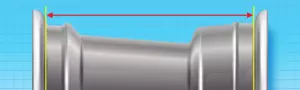
Determine the width of wheels, in most cases this is stamped on the mounting pad of your wheel or behind a spoke (if the manufacturer was nice enough to do so). If you don’t know the width or it’s not stamped on the back of the wheel you can measure the width by measuring from wheel flange to wheel flange.
If your wheel has tires on them you can lay the wheel down face first (don’t forget to protect the face), lay a ruler straight across the tire and measure from the floor to the ruler you just laid across the tire. A typical wheel has total flange of one inch so a good estimation will be to take the width you measured and subtract one inch for the wheel flange.
2. Determine your centerline, this is your wheels width divided by two being the dead center of your wheel.
3. Measure your backspacing. With the wheel laying flat on its face measure the distance between the mounting pad of the wheel and the outer edge of the wheel barrel.
4. Now that you know your wheels width, backspacing and centerline we can calculate your offset.
Centerline – Backspace = Offset
To convert inches to millimeters, multiply inches by 25.4 & to convert millimeters to inches, divide mm by 25.4
In Example: Let’s say your wheels is 10 inches wide, your centerline is 5 inches. For this example let’s say your backspace is 4 inches. 5 – 4 = 1 and 1 inch in millimeters is -25.4 so this means your wheels offset is -25mm (always round). In the case where the backspace is higher than your centerline your offset is positive.
Wheel Offset vs Backspacing
In the above section we learned about backspacing thru the necessity of having to measure for the offset. If you skipped that section, the backspace of a wheel is the distance from the outer edge of the wheel to the mounting pad. While the offset of the wheel is the distance from the centerline of the wheel to the mounting pad.
History of Offset And The Transition of Term Usage
Traditionally it was common to reference only backspacing as all the vehicles manufactured at the time required low offset wheels so it was easier to reference the backspacing. In 1984 Chevrolet introduced the C4 Corvette which was possibly one of the first american vehicles to require high offset wheels.
By this point the wheel manufacturers would stamp on the mounting pad the offset and begin to use the offset term as a primary reference. The stamp would like something like this 8.5Jx17 ET35 where the offset is referenced as ET which is the German word EinpressTiefe meaning offset.
By the 1990s more vehicles were being manufactured that required high offset wheels and the term offset begun to gain traction over backspacing.
As of today backspacing and even front spacing are truly the most important variables in custom wheel manufacturing where a precision fitment is a must.
However for the cast wheel industry and a greater portion of the factory and aftermarket wheels being produced offset is going to be the measurement primarily referenced.
The offset of the wheel is a measurement taken from the centerline of the wheel to the mounting pad of the wheel. The higher the offset the closer the wheel is to your chassis. If you used our Search By Vehicle tool we will only show you offset ranges that are within range for your vehicle.
If you used our Search By Vehicle tool please read the below:
For Cars: The offset ranges offered will result in wheels that will never stick out of your fenders. If you prefer a Flush with the fender look a lower offset will help achieve that.
For Trucks: The offset ranges offered will result in either a flush or slight poke look. If you prefer for the wheels not to poke outside the fenders look for the highest offset available.
For Lifted Trucks: Considering lifted vehicles require larger tires we’re required to keep the wheels as far away from the chassis as possible to prevent rubbing. Depending on your lift and the size of the tire required, the offset ranges offered will result in either a flush look or in some cases will stick outside the fenders. The larger the lift and tire size required the more the wheels will sit outside the fenders. If you’re looking for the wheels to stick outside the fenders look for the lowest possible offset being offered as well as the widest wheel.
ASAPShippingPackages arrive to you the quickest. 92% of ASAP Shipping Packages arrive within six working days or sooner.
Non ASAP Shipping Packages typically ship out within four to ten working days. In 78% of cases products will arrive within ten working days or sooner.
ASAPShippingWheels arrive to you the quickest. 82% of ASAPShippingWheels arrive within three working days or sooner.
Non ASAP Shipping Wheels are typically delivered eight working days or sooner.
Tire options exist for this wheel that would make for an ASAP Shipping (package). The ASAP Shipping tire options will be denoted on the ‘View Tire Options’ page.
Standard Shipping
Standard Shipping products typically ship out within four to ten working days. In 78% of cases products will arrive within ten working days or sooner.
The noted promotion is available from the manufacturer. After your purchase we'll instruct you on how to obtain the rebate on the Thank You page