


Jeep Wrangler Wheel and Tire Fitment Guide: JL, JK, TJ, YJ and Gladiator
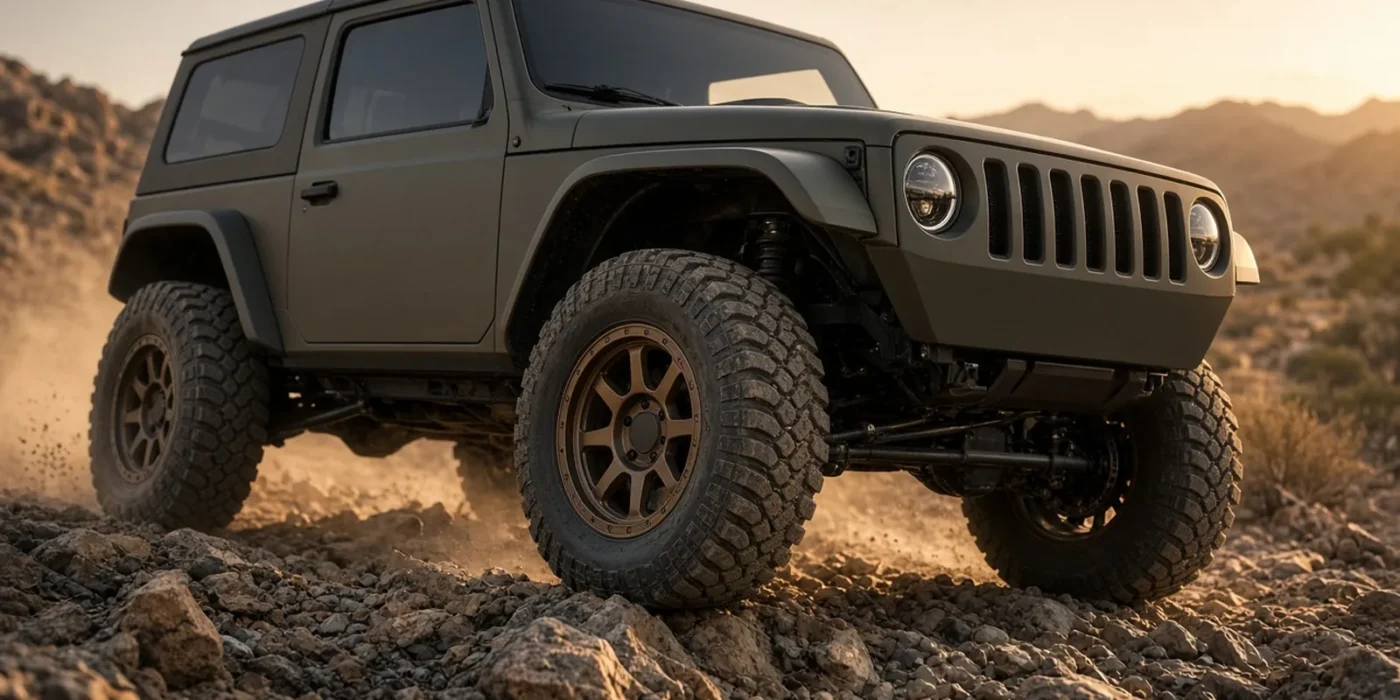
Every Wrangler JK, Wrangler JL, and Gladiator JT uses a 5×5 (5×127 mm) bolt pattern with a center bore of about 71.5 mm. TJs and YJs use 5×4.5, and many of those Jeeps run 15×8 5×4.5 wheels. JL and JT studs are M14 x 1.5; JK studs are 1/2″-20. A stock JL clears 33-inch tires. 35s usually need about 2.5 inches of lift; 37s, 3.5 inches or more.
That paragraph settles most of the questions we get about Jeep wheels. The rest of this guide covers the details that cause trouble: backspacing, the spare, gearing, TPMS, lug hardware, and the steering shake owners call death wobble. We wrote it from the factory documents and from the questions that come across our fitment desk. If a number below is a typical range and not a factory spec, we say so.
The short version of how we work: tire size comes first, then lift, then the wheel. Pick the wheel first because you like the look, and you can end up with a 37-inch tire on a Jeep geared and sprung for 32s. Our Jeep Wrangler wheels page only shows wheels and tires that fit the year, trim, and suspension you enter, and those results are covered by our 100% Fitment Guarantee. Read this guide first so you know what to enter.
What bolt pattern, center bore, and lug thread does each Wrangler generation use?
There are two bolt patterns and two stud threads across the Wrangler family, and the generation boundary between them is where most mistakes happen. The YJ (1987 to 1995) and the TJ (1997 to 2006) use 5×4.5, which is the same pattern as 5×114.3 mm. Jeep moved to 5×5 (5×127 mm) with the JK in 2007 and kept it for the JL and the Gladiator. The stud thread changed later. The JK kept the 1/2″-20 stud, and the JL switched to metric M14 x 1.50.
| Generation | Model years | Bolt pattern | Stud / lug thread | Center bore | Factory lug torque (owner’s manual) |
|---|---|---|---|---|---|
| YJ | 1987–1995 | 5×4.5 (5×114.3 mm) | 1/2″-20 | Measure; varies by axle | See your owner’s manual |
| TJ | 1997–2006 | 5×4.5 (5×114.3 mm) | 1/2″-20 | Measure; varies by axle | 95 ft-lb (130 N·m) in the 2005 manual |
| JK | 2007–2018 | 5×5 (5×127 mm) | 1/2″-20, 19 mm socket | About 71.5 mm | 95 ft-lb (130 N·m) in 2008–2013 manuals; 100 ft-lb (135 N·m) in 2016–2017 manuals |
| JL | 2018–present | 5×5 (5×127 mm) | M14 x 1.50, 22 mm socket | About 71.5 mm | 130 ft-lb (176 N·m); swing-gate spare 59 ft-lb (80 N·m) |
| Gladiator JT | 2020–present | 5×5 (5×127 mm) | M14 x 1.50 | About 71.5 mm | See your Gladiator owner’s manual |
The JL figures come straight from the torque table in the 2024 Jeep Wrangler owner’s manual, which lists 130 ft-lb on M14 x 1.50 studs with a 22 mm socket. It also lists a separate 59 ft-lb value for the spare on the swing gate. The manual tells you to tighten in a star pattern until each nut has been tightened twice, and to check torque again after 25 miles (40 km). Use the manual for your own model year. Jeep has changed the JK value at least once, and we would rather you read your book than trust a forum post.
The center bore is the hole in the middle of the wheel that fits over the hub pilot. Our Wrangler and Gladiator pages list about 71.5 mm for the JK, JL, and JT. Plenty of aftermarket 5×5 wheels are bored larger so one casting fits several vehicles. If the wheel bore is bigger than the hub, the wheel is lug-centric unless you add a hub-centric ring. We supply precision hub-centric rings when the wheel needs them. On a heavy tire that sees trail impacts, that ring is cheap insurance against vibration and stud loading.
Will JK wheels fit a JL, and will JL wheels fit a JK?
The bolt pattern matches, so the wheel will bolt up. The lug nuts will not carry over. A JK nut is 1/2″-20 and a JL stud is M14 x 1.50, and forcing the wrong thread ruins the stud. Offset is the other catch. Factory JK and JL wheels are high positive offset, so moving a factory wheel between generations is usually fine. Moving an aftermarket wheel picked for a lifted JK onto a stock JL is a different question, which the backspacing section below answers. Shopping by bolt pattern alone is how people end up with the right holes and the wrong fit. If you do it anyway, start with our 5×127 (5×5) wheels and filter by backspacing, not just diameter.
What about TJ and YJ owners?
A TJ or YJ needs a 5×4.5 wheel. Do not use wobble bolts to make a 5×5 wheel fit. Bolt-on pattern adapters exist, but they add width and another joint that has to stay torqued, and we would rather sell you the right pattern. Owners who want 5×5 on a TJ usually get there with an axle swap, which is a drivetrain project, not a wheel order. TJs and YJs also run smaller tires than a JL on similar lift, because the wheel openings and stock axles are smaller. The lift guidance below is written for the JK and JL. Apply it to a TJ only after a specialist has looked at your actual suspension.
What wheel and tire sizes came on each Wrangler trim?
The size printed on your door-jamb placard is the baseline for everything else: load index, tire pressure, the TPMS setting, and your speedometer. The JL table below uses Jeep’s published 2024 Wrangler specifications. The 2024 Wrangler specification sheet from Stellantis lists the wheel size, tire size, and revolutions per mile for each trim. Later model years have moved trims around (for example, Willys moved to 33-inch tires for 2024), so confirm on your own placard.
| Trim | Factory wheel | Factory tire | Approx. tire diameter | Revs per mile | Axle ratio |
|---|---|---|---|---|---|
| Sport | 17 x 7.5 steel | P245/75R17 | 31.5 in. | 666 | 3.45 |
| Sport S | 17 x 7.5 cast aluminum | P245/75R17 | 31.5 in. | 668 (all-terrain option) | 3.45 |
| Sahara | 18 x 7.5 cast aluminum | P255/70R18 | 32.1 in. | 650 | 3.45 |
| Rubicon and Willys | 17 x 7.5 cast aluminum (Rubicon) | LT285/70R17C | 32.7 in. (sold as a 33) | 637 | 4.10 (4.88 optional on Rubicon 3.6L) |
| Xtreme 35 Package and Rubicon 392 | 17 x 8 beadlock-capable cast aluminum | LT315/70R17C | 34.4 in. (sold as a 35) | 604 | 4.56 |
Diameters in that table are calculated from the tire size, so treat them as nominal. A real tire varies by brand and tread depth. The revolutions-per-mile figures are Jeep’s. Two details in Jeep’s own spec sheet are worth noticing. The Rubicon’s front and rear track is 64.4 inches, against 62.9 inches on the Sport, and the Xtreme 35 Package and Rubicon 392 widen that to 66.9 inches. The same wheel will sit differently on a Sport and a Rubicon. Jeep’s own 35-inch package also comes with a 1.5-inch factory suspension lift, swing gate reinforcement, wheel flare extensions, and 4.56 gears. That is the factory telling you what 35s take.
The 4xe follows its trim. Rubicon and Willys 4xe models run the same LT285/70R17C tire as the gas Rubicon, and the owner’s manual lists 255/70R18 and 275/55R20 among the 4xe sizes, the 20-inch on High Altitude. The 4xe carries a battery pack and is heavier than a comparable gas Wrangler, so pay close attention to load index when you replace tires. For 2024, Jeep made the Xtreme 35 Package standard on the Rubicon 392, with 4.56 gears, and the newer Willys 392 also comes on 35-inch tires and 17-inch beadlock-capable wheels.
On the JK, factory sizes moved around more across twelve model years. At launch, Jeep’s 2007 specifications (the European-market sheet) listed a 16 x 7 steel wheel on the Sport and 17 x 7.5 aluminum wheels on the Sahara and Rubicon, and later JK Saharas were offered on 18-inch wheels. Most JK Rubicons left the factory on 32-inch-class tires. Read the placard. On a JK that has passed through three owners, the tires on it now tell you nothing about what Jeep put on it.
What about the Gladiator JT?
The Gladiator shares the JL’s 5×5 pattern, M14 x 1.50 studs, and roughly 71.5 mm bore, so wheel hardware carries over. For 2026, Jeep lists 17-inch wheels across the line, with 245/75R17 tires on the Sport, LT255/75R17C on the Willys, and LT285/70R17C Falken Wildpeak tires on the Rubicon and Mojave. The standard axle ratio is 3.73, with 4.10 on the Max Tow package and the off-road trims. The Gladiator is longer and heavier than a Wrangler, and it carries its spare under the bed, not on a swing gate. That changes the spare-tire problem, which we cover below. You can see current fitments on our Jeep Gladiator wheels and tire packages page.
How do offset and backspacing change what fits on a Wrangler?
Offset is the distance in millimeters from the wheel’s centerline to its mounting face. Backspacing is the distance in inches from the mounting face to the inner lip. They describe the same thing two different ways. Backspacing tells you how much room you have inboard, toward the control arms, tie rod, track bar, and brakes. Width plus offset tells you how far the tire sticks out past the fender, which is where flare rub, mud on the doors, and scrub radius come from.
Our offset and backspacing calculator uses the standard shop formula: backspacing in inches equals the wheel width plus one, divided by two, plus the offset in millimeters divided by 25.4. The extra inch accounts for the bead flanges. We used that formula for the table below. Factory JK and JL 17 x 7.5 wheels are commonly listed at about +44 mm, which works out to about 6 inches of backspacing. Check the stamping on yours before you compare.
| Wheel | Offset | Backspacing | Outboard depth (mounting face to outer lip) | Change per side vs. a +44 mm 17 x 7.5 |
|---|---|---|---|---|
| 17 x 7.5 (factory-style) | +44 mm | 6.0 in. | 2.5 in. | Baseline |
| 17 x 8.5 | -6 mm | 4.5 in. | 5.0 in. | About 2.5 in. farther out |
| 17 x 9 | 0 mm | 5.0 in. | 5.0 in. | About 2.5 in. farther out |
| 17 x 9 | -12 mm | 4.5 in. | 5.5 in. | About 3.0 in. farther out |
| 20 x 10 | -18 mm | 4.8 in. | 6.2 in. | About 3.7 in. farther out |
| 20 x 12 | -44 mm | 4.8 in. | 8.2 in. | About 5.7 in. farther out |
Look at the last row. A 20 x 12 at -44 mm has almost the same backspacing as a 20 x 10 at -18 mm, so the inboard clearance is nearly identical. The 12-inch wheel puts the tire about two inches farther outboard on each side. That is a real build style. Here is a JK we documented on 20 x 12 XD137 wheels and 37-inch Nitto tires at exactly that offset. It is also the reason we ask what the Jeep is for before we sell that setup. Big poke means more leverage on the steering and ball joints, more spray on the body, and in some states a question about fender coverage.
For a Wrangler that is driven to work and on the trail on weekends, most of the aftermarket ends up around 4.5 to 5 inches of backspacing on a 17 x 9 or 17 x 8.5. That is enough to pull a 12.50-wide tire away from the control arms and track bar on most JK and JL front ends. It also keeps the tire close enough that the flares still cover much of the tread. Treat that as a typical range. Your bumpers, fenders, and suspension decide the rest, and our explanation of wheel offset and how to measure backspacing shows how to measure a wheel you already own.
What size tires fit a Wrangler on stock suspension, a 2.5-inch lift, and a 3.5-inch-plus lift?
The table below shows the starting points our specialists use for the JK and JL. These are typical ranges, not factory specs and not a guarantee. Static clearance with the Jeep parked is only half the test. At full flex, with the axle stuffed into the bump stop and the wheel turned to lock, the tire goes where the fender, bumper, and control arm already are. Bump stops, fender style, and how hard you wheel decide where your build lands within each range.
| Tire | Stock height | About 2.5 in. of lift | 3.5 in. of lift or more | Typical wheel and backspacing |
|---|---|---|---|---|
| 33 in. (285/70R17, 285/75R17, 275/65R18 class) | Fits most JLs; JL Rubicon and Willys ship on 33s. Usually fits a JK. | Fits with room to flex | Fits; more lift than a 33 needs | 17 x 8.5 or 18 x 9, about 4.5 to 6 in. backspacing |
| 35 in. (35×12.50R17/R18/R20, 315/70R17) | Tight. Jeep’s own Xtreme 35 Package adds a 1.5 in. lift and flare extensions. Expect rub at full flex without bump stop or fender work. | The common target for daily-driven 35s | Fits with more up-travel | 17 x 9 or 18 x 9, about 4.5 to 5 in. backspacing |
| 37 in. (37×12.50R17/R18/R20) | Not recommended | Only with high-clearance fenders, longer bump stops, and accepted rub | The usual starting point, with fender and bump stop work | 17 x 9 or 17 x 10, about 4.5 to 5 in. backspacing |
The diameters and widths in that table match the combinations on our Wrangler and Gladiator pages: 285/70R17 or 285/75R17 on a 17 x 8.5 for stock and mild lifts, 35×12.50 on 17 x 9 to 20 x 9 wheels, and 37×12.50 on 17 x 9, 17 x 10, and 20 x 10 wheels for properly lifted rigs. If you are going to 35s, our 35 inch tires page lists all-terrain, mud-terrain, and hybrid patterns. Before you pick a tread, check the load range against your placard.
Two things stop people before tire size does. The first is the front end at full lock, where a 12.50-wide tire on factory backspacing can contact the track bar or steering linkage on many JKs and JLs. The second is the JL rear, where a tire that clears parked can hit the fender liner when the axle articulates. Lower backspacing helps the first problem. Bump stops and fender choice fix the second.
Do you need to regear after going to bigger tires?
A bigger tire makes the Jeep effectively taller-geared. The math is simple: effective ratio equals your axle ratio times the old tire diameter, divided by the new tire diameter. A JL Sport with a 3.45 axle on 31.5-inch factory tires that moves to 35s drops to about 3.10 effective. To get the original feel back on 35s, you would need about 3.83. A Rubicon with 4.10 gears on 32.7-inch tires that moves to 37s drops to about 3.62 effective.
| Starting point | New tire | Effective ratio | Ratio needed to match the original |
|---|---|---|---|
| JL Sport, 3.45, 31.5 in. | 35 in. | About 3.10 | About 3.83 |
| JL Rubicon, 4.10, 32.7 in. | 35 in. | About 3.83 | About 4.39 |
| JL Rubicon, 4.10, 32.7 in. | 37 in. | About 3.62 | About 4.64 |
Jeep’s own choices are a good reference. The factory pairs 33s with 4.10 gears on the Rubicon and 35s with 4.56 gears on the Xtreme 35 Package and the 392, and it offers 4.88 on some Rubicon models. Our opinion is that a 3.45 Jeep on 35s will drive, but it will feel slow and shift a lot on grades, and an automatic can run hotter when towing. On 37s, plan for regearing in the budget. You will also need the speedometer recalibrated. Jeep’s revolutions-per-mile figures show the size of the error: a Sport (666 revs per mile) that moves to the 35-inch LT315/70R17C (604) without recalibration reads 60 mph when it is doing about 66. The owner’s manual also warns that tire size changes affect adaptive cruise and forward collision warning, so get the calibration done properly.
How big a spare can the Wrangler’s tailgate carry?
The swing gate on a JK or JL was designed around the factory spare, and a 35- or 37-inch mud-terrain on a heavy wheel puts a lot more weight on the hinges and the carrier. Jeep’s own Xtreme 35 Package adds swing gate reinforcement, and the 2024 spec sheet lists overall length, which Jeep measures including the spare, about 4.1 inches longer with that package. We read that as the factory confirming that a bigger spare needs a stronger mount.
For 35s, plan on a relocation bracket or reinforced carrier so the spare clears the tailgate and the third brake light, and tighten the spare lugs to the separate 59 ft-lb value Jeep lists for the swing gate, not the 130 ft-lb road-wheel value. For 37s, many owners move to a bumper-mounted or hinge-reinforced carrier. On a Gladiator, the spare lives under the bed, so the limit is the space under there and the winch mechanism, not the tailgate. A tire that fits the wheel wells may not fit under the bed.
Match the spare to the other four. On a 4×4, running a spare that is a different diameter from the other tires puts extra load on the transfer case and lockers. A full-size matching spare also lets you do a five-tire rotation, which evens out wear on mud-terrains.
Will TPMS work with new wheels on a Wrangler?
Every JL and Gladiator has a tire pressure monitoring system, and so does nearly every JK. Federal Motor Vehicle Safety Standard 138, in the Code of Federal Regulations at 49 CFR 571.138, requires covered vehicles up to 10,000 pounds GVWR to warn the driver within 20 minutes when a tire drops 25 percent below the recommended cold pressure. The rule was phased in from model year 2006 and required on all covered light vehicles built on or after September 1, 2007. YJs and most TJs predate it.
The JL owner’s manual is blunt about the risk: TPMS is optimized for the original wheels and tires, replacement equipment of a different size, type, or style can cause undesirable operation or sensor damage, and aftermarket wheels can damage sensors. Two practical points follow. If you change tire size and pressure, set the placard pressure the system watches to suit the new tire, which may need a programmer or a dealer visit. And reuse old sensors only if they are healthy. We covered whether your old TPMS sensors can move to new wheels in a separate post. When you add TPMS to a package at checkout, we install the sensors in the wheels and program them to your Jeep before the set ships.
What lug nuts and hub-centric rings does a Wrangler need with aftermarket wheels?
Get three things right: thread, seat, and length. The thread is 1/2″-20 on a JK, TJ, or YJ, and M14 x 1.50 on a JL or JT. The seat is the part that actually clamps the wheel. Most aftermarket wheels use a conical (60-degree) seat, and that may not match the factory nut, so do not reuse factory nuts on aftermarket wheels until you have checked the seat. Length matters because thick aluminum off-road wheels need enough thread engagement, and because a lug that bottoms out on the stud can read correct torque while holding nothing.
The manual’s instruction to use dealer-recommended nuts, clean the threads, keep oil off, and inspect the mounting face applies just as much to aftermarket hardware. We offer Gorilla spline lug hardware and precision hub-centric rings when a wheel requires them. If the wheel bore matches the 71.5 mm hub, it needs no ring. If the bore is larger, add the ring. Torque with a calibrated wrench, not an impact gun, and re-check after the first 25 miles.
Do bigger tires cause death wobble?
Bigger tires do not cause death wobble on their own. They make whatever is already loose show up faster. Death wobble is the violent front-end oscillation, usually set off by a bump at highway speed, that only stops when you slow down. On a solid front axle, it usually traces back to a worn or loose track bar, track bar bushings or bolts, ball joints, tie rod or drag link ends, control arm bushings, or a steering damper that is not doing its job. Heavy tires, low backspacing, and poor balance add energy to the system.
Jeep has acknowledged a damper-related shimmy. In 2019, FCA’s Customer Satisfaction Notification V41 replaced the steering damper on about 192,000 2018 and 2019 JL Wranglers for a shake that showed up after bumps above 55 mph and in cold weather. A later FCA technical service bulletin filed with NHTSA (19-002-24 Rev. A) lists air trapped in the steering damper as the cause of a shimmy after road irregularities. It covers 2020 Gladiators, 2018 JKs, and 2018 to 2020 JLs built on or before August 11, 2020, with a warranty extension to 8 years or 90,000 miles for that repair. If your Jeep is on that list, have a dealer check it before you change the tires.
Our position is simple: a bigger steering stabilizer hides the symptom without fixing the cause. Before a 35- or 37-inch package goes on, check the front end with the Jeep on the ground and someone turning the wheel while you watch each joint. Tighten the track bar to spec, get the alignment and caster right for the lift, and have the tires balanced properly. Road Force balancing is an optional upgrade on our packages, and on big mud-terrains it is worth considering.
Are beadlock wheels street legal?
There is no single federal answer, and anyone who gives you a simple yes is guessing. What is clear is how the manufacturers label them. A true beadlock clamps the outer bead between the wheel and a bolted ring so you can air down very low without the tire coming off the bead. Raceline, for example, labels its Monster forged beadlock as for off-road use only and not DOT approved for highway use, and that wording is typical across the category. State inspection and equipment rules vary, and a ring with loose or missing bolts is a real failure risk at speed.
Do not confuse a true beadlock with a “beadlock-capable” or simulated-beadlock wheel. Jeep’s 17 x 8 Xtreme 35 and 392 wheels are described as beadlock capable and ship with a trim ring. Many popular aftermarket wheels use a cosmetic ring with no clamping function. Those are ordinary street wheels. If you want true beadlocks, we would rather you run them on a dedicated trail set and drive to the trail on something else.
How do we build a Wrangler wheel and tire package?
Most Wrangler orders we see are complete sets, because tire size, wheel width, and backspacing have to be chosen together. We mount and balance every package on Hunter equipment, run a fitment check, and offer TPMS, lug hardware, rings, and Road Force balancing as options at checkout. Our guide to how we mount and balance packages explains what happens before a set ships.
If you are still comparing sellers, our guide to buying rims online covers what a fitment guarantee should include.
A 37-inch package plus a lift and gears adds up fast. If you are spreading the cost out, read our explainer on how to finance wheels and tires first, because a lease and a loan cost very different amounts by the end of the term.
If you find the identical set cheaper at an authorized online retailer, our price match policy compares delivered prices, including shipping and fees.
Changing the tire size away from what our Search By Vehicle tool allows can void the Fitment Guarantee, so tell us about your lift and fenders before you order, not after. Our return policy accepts eligible unused wheels within 60 days of delivery if they have not been mounted, driven on, or installed, with original packaging. Special-order wheels are excluded unless the problem is a fitment issue covered by the guarantee.
What should you check before you order Wrangler wheels and tires?
Run this list in order. It is the same order our specialists use on the phone.
- Identify the generation and trim. Confirm YJ, TJ, JK, JL, or Gladiator JT from the model year, and read the trim. The bolt pattern changes at the JK (5×4.5 to 5×5) and the stud thread changes at the JL (1/2″-20 to M14 x 1.50).
- Read the door placard. Write down the factory tire size, load index, and cold inflation pressure. Your replacement tires should not have a lower load index than the originals.
- Choose the tire size first. Decide between 33, 35, or 37 inches based on how the Jeep is used, then choose the lift that size needs: stock for most 33s, about 2.5 inches for 35s, 3.5 inches or more for 37s.
- Pick wheel diameter, width, and backspacing for that tire. For 35s and 37s, a 17 x 9 or 17 x 8.5 with about 4.5 to 5 inches of backspacing is the typical starting point. Run the numbers in an offset and backspacing calculator before ordering.
- Confirm bolt pattern, center bore, and lug hardware. Match the bolt pattern, use a hub-centric ring if the wheel bore is larger than the roughly 71.5 mm hub, and buy lug nuts with the right thread and seat for the new wheel.
- Plan TPMS and the spare. Order TPMS sensors or confirm your old ones are healthy, and plan the spare: a matching fifth wheel, a carrier that can hold its weight, and the 59 ft-lb swing-gate torque on a JL.
- Plan gearing and speedometer calibration. Calculate the effective axle ratio on the new tire, budget for regearing on 37s, and have the speedometer and tire size recalibrated.
- Install, torque, and re-check. Torque to the owner’s manual value in a star pattern (130 ft-lb on a JL), re-check after 25 miles, inspect the front end, and get an alignment if lift, tire size, or offset changed.
Frequently asked questions
What is the bolt pattern on a Jeep Wrangler?
The Wrangler JK (2007–2018), Wrangler JL (2018–present), and Gladiator JT use a 5×5 bolt pattern, which is the same as 5×127 mm, with a center bore of about 71.5 mm. The TJ (1997–2006) and YJ (1987–1995) use 5×4.5, the same as 5×114.3 mm.
Will JK wheels fit a JL Wrangler?
Usually, yes. The JK and JL share the 5×5 bolt pattern, so the wheel bolts up, but the lug nuts do not carry over. JK studs are 1/2″-20 and JL studs are M14 x 1.50. Check the offset as well, because an aftermarket wheel picked for a lifted JK may not suit a stock JL.
Can you fit 35-inch tires on a stock Jeep Wrangler?
Not without compromise. Jeep’s own Xtreme 35 Package adds a 1.5-inch factory lift, flare extensions, swing gate reinforcement, and 4.56 gears to run LT315/70R17 tires. On a standard JL or JK, most owners add about 2.5 inches of lift. At stock height, expect rub at full flex unless you add bump stop or fender work.
What backspacing do you need for 35s or 37s on a Wrangler?
A typical starting point for 35- and 37-inch tires on a JK or JL is about 4.5 to 5 inches of backspacing, usually on a 17 x 9 or 17 x 8.5 wheel. Factory 17 x 7.5 wheels run about 6 inches. Lift, bump stops, and fenders decide the final answer, so treat this as a range, not a guarantee.
Do you need to regear a Wrangler for bigger tires?
On 37s, plan on it. On 35s, it depends on your current ratio. Effective ratio equals the axle ratio times the old tire diameter divided by the new one, so a 3.45 JL Sport on 35s drops to about 3.10. Jeep pairs 35s with 4.56 gears on the Xtreme 35 Package and the 392.
Will my Jeep’s TPMS sensors work with new wheels?
Usually, if the sensors are healthy and the wheel accepts them. The JL owner’s manual warns that the system is optimized for factory wheels and tires and that aftermarket wheels can damage sensors. If you change tire size and pressure, the pressure the system watches may need to be reprogrammed.
Do bigger tires cause death wobble?
Not by themselves. Bigger, heavier tires expose worn or loose parts such as the track bar, ball joints, tie rod ends, and the steering damper. FCA replaced steering dampers on about 192,000 2018–2019 JLs under Customer Satisfaction Notification V41, and a later service bulletin extended damper coverage on certain JL, JK, and Gladiator models.
Are beadlock wheels street legal?
There is no single national answer. Manufacturers of true bolt-on-ring beadlocks commonly label them for off-road use only and not DOT approved for highway use, and state equipment rules vary. Beadlock-capable and simulated-beadlock wheels, including Jeep’s factory 17 x 8 wheels with a trim ring, are ordinary street wheels.
Who can check your Wrangler build before you order?
Send us the year, trim, lift, bumpers, and the tire size you want, and a specialist will tell you what fits and what it will take. You can contact a fitment specialist online at any hour, or call or text 1-866-757-4679 during sales hours, Monday through Friday, 8:30 AM to 6:00 PM Eastern. If the honest answer is that your Jeep needs gears or fenders before 37s, we will tell you that before you spend the money.

